
AB 462: How to Live in Your ADU While Rebuilding Your Palisades Home
AB 462, effective January 2026, allows Palisades fire rebuild homeowners to build a detached ADU, receive a Certificate of Occupancy for it independently, and legally move back to their property — while the primary home rebuild is still in progress. Here is the concise guide to making it work.
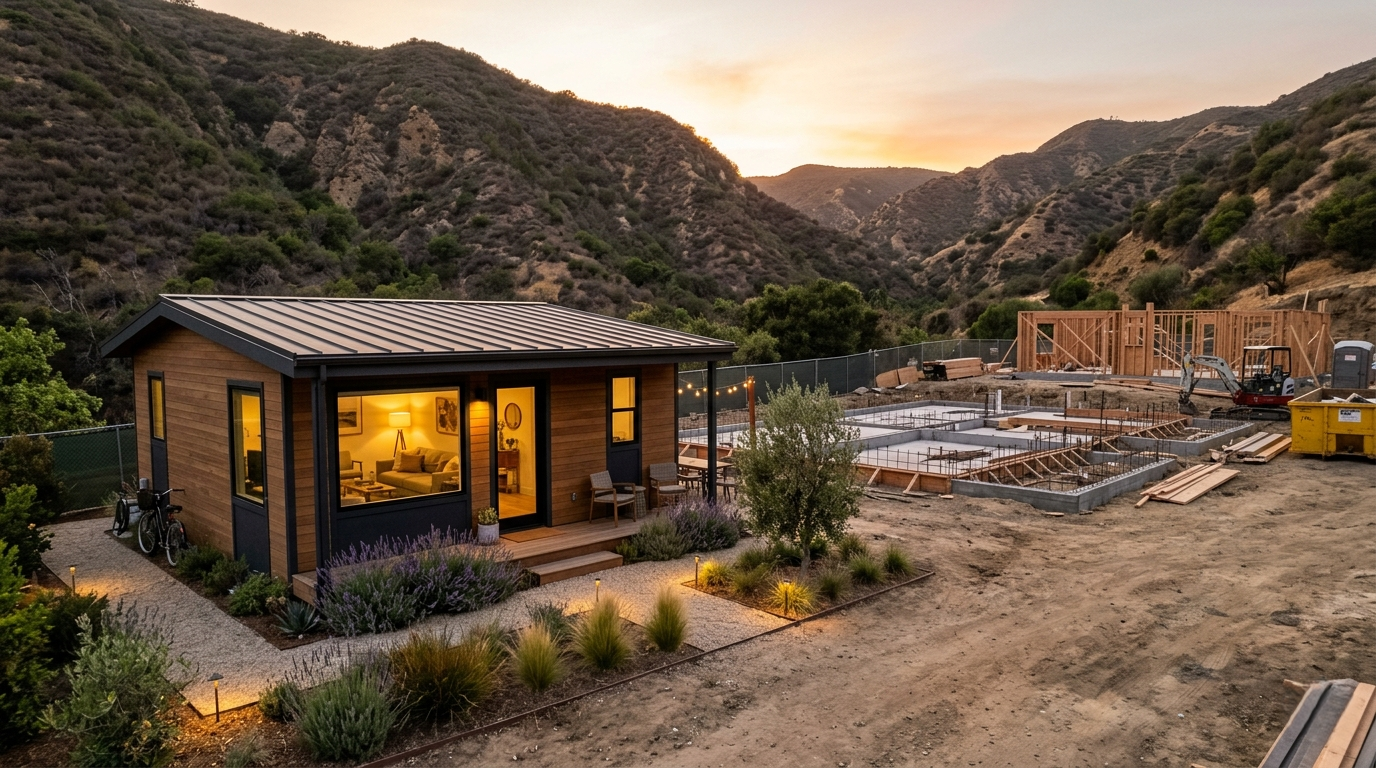
If you lost your home in the January 2025 fires and are still paying rent, AB 462 may be the most consequential legislation affecting your situation in 2026. Here is exactly what it allows, who qualifies, how fast you can move home, and the five steps to execute it this week.
Under AB 462, a detached ADU can now receive its own Certificate of Occupancy completely independently of the primary home — even if the lot has no primary structure on it. For fire rebuild homeowners paying $5,000–$7,000/month in temporary housing, this is the most financially significant change of 2026.
What AB 462 Actually Changed in the Law
Assembly Bill 462, signed September 2025 and effective January 1, 2026, amends California Government Code Section 65852.2 — the primary ADU statute — to explicitly allow a detached ADU to receive a Certificate of Occupancy before the primary dwelling unit is built, reconstructed, or restored on the same lot.
The law applies specifically when the primary dwelling was destroyed or substantially damaged by a declared wildfire disaster. The January 2025 Palisades and Eaton fires both qualify under this provision. There is no time limit on how long you can legally occupy the ADU before the primary home is completed — your CO is valid, you are on your own property, and you can stay until the primary home is habitable.
Who Qualifies Under AB 462
Your primary dwelling was destroyed or substantially damaged by the January 2025 Palisades or Eaton fire — both declared state and federal disasters. A total loss qualifies. A substantial partial loss that renders the home uninhabitable also qualifies.
You intend to rebuild the primary home. The law does not require the primary home to be under active construction — only that you intend to rebuild. Having a permit application in progress satisfies this requirement.
The ADU is a new detached structure. AB 462 requires a detached accessory dwelling unit — not an attached addition, not a garage conversion, not a JADU (Junior ADU). It must be a standalone new construction detached structure with its own foundation, framing, roofing, and utilities.
The ADU meets all applicable codes. This includes full 2026 WUI compliance — Class A roofing, ASTM E2886 ember-resistant vents, noncombustible cladding, defensible space. A non-compliant ADU will not receive its CO.
How Fast Can You Move Back?
The timeline from deciding to pursue an ADU to moving back to your property depends primarily on your lot conditions and which plan pathway you choose:
| Pathway | Permit timeline | Construction | Move-in from start |
|---|---|---|---|
| Pre-approved standard plan — flat/gentle slope lot | 1–5 business days | 14–18 weeks | ~5 months |
| Pre-approved standard plan — hillside lot (soils required) | 1–5 days + 8–12 week soils (parallel) | 16–20 weeks | ~6–7 months |
| Coastal Zone lot — 60-day Coastal Commission review | 60 days (AB 462 mandate) | 14–18 weeks | ~6–7 months |
| Custom architect plan — straightforward lot | 4–8 weeks design + 30–60 days review | 14–20 weeks | ~7–9 months |
Timelines assume immediate contractor engagement and simultaneous submissions to all applicable agencies. Soils reports run in parallel with design and do not add sequential time when started on day one.
Coastal Zone — The 60-Day Rule Under AB 462
Most of Pacific Palisades sits within the California Coastal Zone, which normally requires a Coastal Development Permit for any new structure. For new detached ADUs in the Coastal Zone, AB 462 mandates that the California Coastal Commission must issue a decision within 60 calendar days of receiving a complete application. If no decision is issued within 60 days, the permit is deemed approved automatically by operation of law.
This 60-day mandate makes the Coastal Zone ADU pathway viable for the AB 462 move-home strategy — provided the application is complete when submitted. An incomplete application does not start the 60-day clock, and the Coastal Commission has authority to declare an application incomplete. Work with a contractor who has submitted Coastal Commission CDPs before — the difference between a complete and incomplete first submission is often 6–8 weeks of unnecessary delay.
Five Steps to Execute This Week
- 1
Contact a Palisades fire rebuild contractor with AB 462 experience and schedule a site visit. Confirm they have submitted Coastal Commission ADU permits if your lot is in the Coastal Zone. The site visit is free and your timeline starts the day you engage.
- 2
Review the LADBS standard ADU plan catalog with your contractor at the site visit. Pre-approved plans can permit in 1–5 business days — the fastest path to occupancy. Your contractor should confirm which plans are geometrically compatible with your specific lot dimensions, slope, and setbacks before selection.
- 3
Commission a soils report immediately if your lot is on a hillside. On most Palisades hillside lots this takes 8–12 weeks. Starting it on day one means it arrives before or simultaneously with your permit approval — not after. Every week you delay commissioning it is a week added to your move-in date.
- 4
Submit permits to all applicable agencies simultaneously. For non-Coastal Zone lots: LADBS only. For Coastal Zone lots: LADBS and the Coastal Commission at the same time. Your contractor manages both submissions and ensures they are complete before anything is filed. Apply for the EO No. 7 fee waiver at the same time.
- 5
Site the ADU carefully on the lot. Work with your contractor to position the ADU so it does not conflict with the planned primary home footprint, driveway access, utility connections, or setback requirements. Planning both the ADU and primary home positions simultaneously from the start avoids costly conflicts later and ensures both permit applications can proceed without interference.
"Every month you continue paying $5,500 in rent while your permits are pending is $5,500 that could instead be equity in a permanent asset on your own land — and the permit process costs nothing to start."
What Happens When the Primary Home Is Done
When the primary home rebuild is complete and you receive its Certificate of Occupancy, you move out of the ADU and into the main house. The ADU does not disappear — it becomes a permanent income-producing asset on the lot.
In Pacific Palisades, a well-built 650–800 sq ft detached ADU rents for $3,200–$4,000 per month. At $3,500/month, it generates $42,000 per year in gross rental income. Over a 10-year horizon, that is $420,000 in gross rental income from a structure that also adds $300,000–$500,000 in assessed property value. The ADU-first strategy is not a temporary workaround — it is a permanent upgrade to the long-term value and income potential of your property.
Free site visit. We assess your lot, confirm AB 462 eligibility, and give you a specific timeline and cost estimate — no obligation. CSLB License #982386.