
Opening Up Your Kitchen in a Palisades Home: What Load-Bearing Wall Removal Actually Involves
Most 1950s–1970s Palisades homes have compartmentalized floor plans with load-bearing walls separating the kitchen. Removing them requires structural engineering, a beam solution, and permits — but the result transforms how you live in the home.
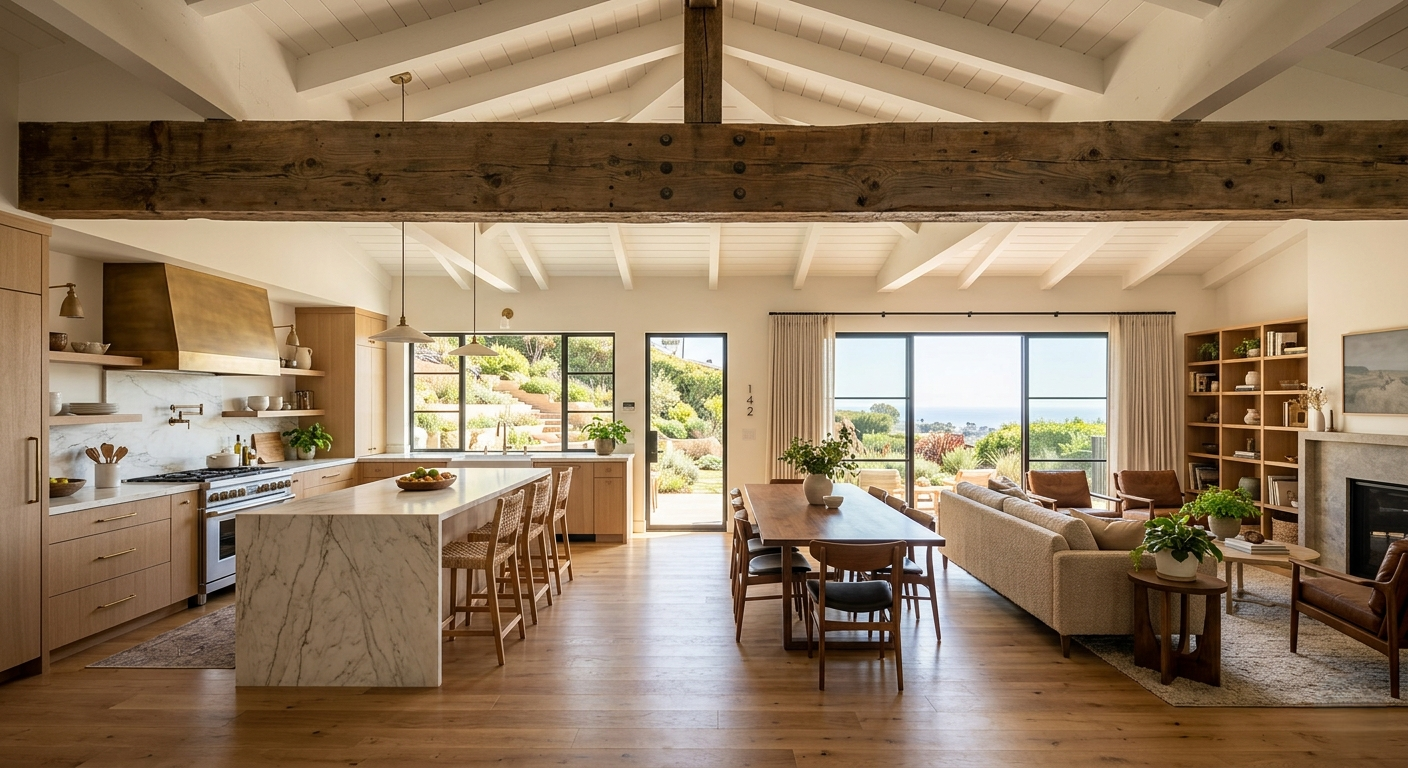
Most 1950s–1970s Palisades homes were built with compartmentalized layouts — separate kitchen, dining room, and living room, divided by walls that the original architect put there for structural reasons. Opening these spaces is one of the most transformative things you can do to a Palisades home — and one of the most technically demanding.
Is That Wall Load-Bearing? How to Know
In Pacific Palisades homes, if a wall is perpendicular to the floor joists above it, runs roughly through the center of the house, or sits directly above a foundation wall or beam below — it is almost certainly load-bearing. In practical terms: if you want to remove a wall that divides your kitchen from any adjacent space in a pre-1980 Palisades home, assume it is structural until a structural engineer confirms otherwise.
A visual inspection by an experienced contractor can give you a strong initial read — but the only definitive answer comes from a licensed structural engineer who has reviewed the framing, the floor system above, and the foundation below. Budget $1,500–$3,000 for this evaluation before committing to any layout change.
This does not mean you cannot remove them — it means you need to plan for the structural engineering, permits, and beam installation that load-bearing wall removal requires. Plan for it from day one and it is a manageable cost. Discover it mid-project and it is a budget crisis.
What Load-Bearing Wall Removal Actually Involves
Removing a load-bearing wall is a multi-step process that requires coordination between your contractor, a structural engineer, and LADBS. Here is the sequence:
- 1
Structural engineering assessment and drawings. A licensed structural engineer reviews the framing, determines the load path, calculates the required beam size and connection details, and produces stamped drawings. Cost: $2,500–$5,000. Timeline: 2–4 weeks.
- 2
Permit application to LADBS. Structural drawings are submitted along with the building permit application. LADBS plan check review: 3–6 weeks for a typical residential structural alteration. Permit fee is based on project valuation — typically $1,500–$4,000 for this scope.
- 3
Temporary shoring installation. Before any existing wall is removed, the structure above it must be supported with temporary shoring posts and beams. This is non-negotiable — removing a load-bearing wall without shoring is an immediate structural risk. Cost: $2,000–$5,000 in labor and temporary materials.
- 4
Wall removal and beam installation. The existing wall framing is removed, the new beam (steel or engineered lumber, depending on the span and load) is lifted into position, and the post and bearing conditions at each end are constructed. The beam typically sits in the ceiling plane or is exposed — your preference influences the design approach. Cost: $8,000–$25,000 depending on span length and beam type.
- 5
MEP (mechanical, electrical, plumbing) relocation. Load-bearing walls often contain electrical circuits, plumbing, HVAC ducts, or other systems that must be rerouted. This is frequently the most expensive surprise in a wall removal project — and the one most commonly underestimated in initial budgets. Cost: $3,000–$15,000 depending on what is in the wall.
- 6
Framing, drywall, and finish. After the beam is installed and all systems are relocated, the new opening is framed, drywall is applied and finished, and the ceiling and floor transitions are addressed. Cost: $5,000–$15,000 depending on scope.
- 7
LADBS inspection and sign-off. The structural work must be inspected and signed off by LADBS before the walls are closed in. Plan for 1–3 inspections at various stages. Timeline: 1–2 weeks for scheduling, depending on inspector availability.
Total Cost: What to Budget for a Full Wall Removal
| Component | Cost range | Notes |
|---|---|---|
| Structural engineering | $2,500–$5,000 | Stamped drawings required for permit |
| Building permit (LADBS) | $1,500–$4,000 | Based on project valuation |
| Temporary shoring | $2,000–$5,000 | Required before any wall framing removed |
| Beam procurement and installation | $8,000–$25,000 | Steel vs. engineered lumber; span-dependent |
| MEP system relocation | $3,000–$15,000 | Highly variable — depends on what's in the wall |
| Framing, drywall, finishes | $5,000–$15,000 | Ceiling, floor transitions, finish work |
| Total (structural work only) | $22,000–$69,000 | Before kitchen remodel costs are added |
These costs are for the structural wall removal work only and are added to the kitchen remodel budget. The total project cost is the kitchen remodel scope plus the structural work scope.
Is It Worth It? The Value Perspective
Removing a load-bearing kitchen wall in a Palisades home — even with all the associated structural, permit, and MEP costs — is almost always worth the investment. Here is why:
Quality of life impact: Open-plan kitchen/living/dining is the single most consistent quality-of-life improvement Palisades homeowners report after a remodel. The way the home functions every day changes fundamentally — not just the kitchen's appearance.
Property value impact: Open-plan layouts command a meaningful premium in the Palisades resale market. A $40,000–$60,000 wall removal investment in the context of a full kitchen remodel typically returns 60–90 cents on the dollar in appraised value increase in this market.
It is harder to do later: Once you have completed a kitchen remodel without removing the wall, revisiting the wall removal means tearing out finished kitchen work. Do the structural work as part of the initial remodel scope — not as a second project later.
We handle everything from the initial engineer assessment through final LADBS inspection. Free consultation. CSLB License #982386.