
Build Your ADU First:
How AB 462 Lets You Move Home
Before Your Rebuild Is Done
Under AB 462, effective January 2026, Pacific Palisades homeowners can build a detached ADU, receive a Certificate of Occupancy for it independently, and legally move back to their property — while the primary home rebuild is still in progress.
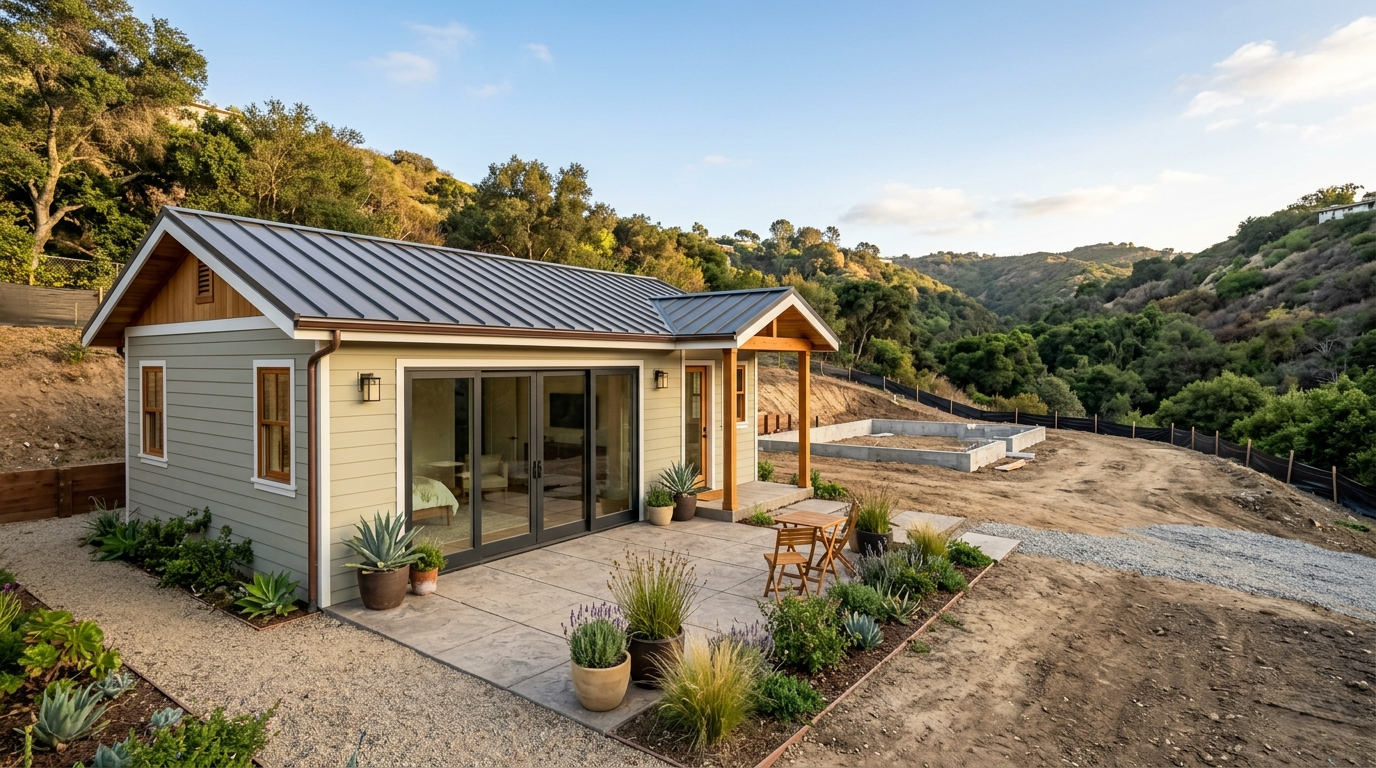
Most Palisades homeowners assume that the only path back to their property is completing the full rebuild — a process that can take two to three years from start to finish. AB 462 changes that entirely. Here is how it works, who qualifies, and how to use it to move home far sooner than you thought possible.
Assembly Bill 462 severs this dependency. A detached ADU can now receive its own Certificate of Occupancy completely independently — even if the lot has no primary home on it. For fire rebuild homeowners, this is the single most important legislative change of 2026.
The Problem This Solves
When the January 2025 fires destroyed thousands of Pacific Palisades homes, the families who lost them faced an immediate housing crisis. They needed a place to live while their properties were cleared, permitted, and rebuilt — a process that, under realistic timelines, takes a minimum of 18 months and often 24–36 months from start to move-in.
Most families are paying rent somewhere in Los Angeles — at rates that average $4,500–$7,500 per month for a home comparable to what they lost. Over 24 months, that is $108,000–$180,000 in rent, paid while also managing a rebuild, an insurance claim, a contractor, and multiple permit agencies simultaneously.
"Two years of rent in Pacific Palisades costs more than most ADUs to build. The math is straightforward — the strategy is not yet widely understood."
The ADU-first strategy under AB 462 addresses this directly. Instead of waiting for the full rebuild, you build a detached ADU on your lot first — and move back to your property while the primary home rebuild continues around you.
The Math: ADU-First vs Waiting
Here is a concrete comparison between two Palisades homeowners with identical properties and identical insurance settlements — one uses the ADU-first strategy, one does not.
The difference in rent paid alone is over $140,000 — more than enough to fund a substantial portion of the ADU construction itself. And the families are not equivalent in their experience of the rebuild: the ADU-first family is living on their property, watching their home go up, and not paying rent for the final 26 months of construction.
How AB 462 Works — The Legal Framework
Assembly Bill 462 was signed into law in September 2025 and took effect January 1, 2026. It amends Section 65852.2 of the California Government Code — the primary ADU statute — to explicitly allow a detached ADU to receive a Certificate of Occupancy before the primary dwelling unit is built, reconstructed, or restored.
The law applies specifically when:
The primary dwelling was destroyed or substantially damaged by a declared wildfire disaster (the January 2025 Palisades and Eaton fires qualify)
The ADU is a detached accessory dwelling unit — not an attached ADU, junior ADU (JADU), or conversion of an existing non-habitable space
The applicant holds ownership of the lot and intent to rebuild the primary home
The ADU meets all applicable 2026 WUI code requirements (Class A roofing, ember-resistant vents, noncombustible cladding)
AB 462 in the Coastal Zone — The 60-Day Rule
Most of Pacific Palisades sits within the California Coastal Zone, which normally means any new structure requires a Coastal Development Permit (CDP) from the California Coastal Commission. For fire rebuild homeowners, the executive orders suspended the CDP requirement for primary home rebuilds — but ADUs in the Coastal Zone are handled differently under AB 462.
AB 462 includes a specific provision for Coastal Zone ADUs: the Coastal Commission must issue a decision on a complete CDP application within 60 days of receiving it. If the Commission fails to act within 60 days, the permit is deemed approved automatically.
Before AB 462, Coastal Commission review for an ADU in the Coastal Zone could take 6–18 months. The 60-day mandate cuts this to a fraction of the previous timeline. A complete, well-prepared application — submitted by a contractor experienced with Coastal Commission requirements — should move through in 45–60 days.
The key word is "complete." An incomplete application does not start the 60-day clock. Your contractor must ensure the application is fully documented before submission.
Step-by-Step: How to Execute the ADU-First Strategy
Here is exactly how the process works, from the day you decide to pursue an ADU-first approach through the day you move back to your property.
Permit Fees — What's Waived and What You Pay
Under Mayor Bass's Emergency Executive Order No. 7, permit fees are waived for all qualifying fire rebuild properties — and this waiver explicitly covers ADU permits built as part of the fire rebuild process.
| Fee type | Standard cost | Fire rebuild status | Condition |
|---|---|---|---|
| LADBS building permit fee | $3,000–$12,000 | Waived | Owner on title before Jan 7, 2025 |
| Plan check fee | $1,500–$6,000 | Waived | Owner on title before Jan 7, 2025 |
| ADU permit fee | $2,000–$8,000 | Waived | Owner on title before Jan 7, 2025 |
| Coastal Commission CDP fee | $2,000–$5,000 | Waived | Fire-affected property in Coastal Zone |
| School fees (SB 50) | $3–$4 per sq ft | Not waived | Standard rate applies |
| Utility connection fees | Varies by utility | Not waived | Standard utility rates apply |
Waiver eligibility requires proof of ownership before January 7, 2025. You must obtain your building permit by January 13, 2032 to qualify. Apply for the waiver at the time of permit submission — it does not apply retroactively to already-paid fees.
What Kind of ADU Should You Build?
The AB 462 strategy works best with a new detached ADU built specifically for the purpose. Here is how the main options compare for Palisades homeowners in the fire rebuild context:
For most Palisades homeowners, Option B — a site-built ADU — is the better long-term choice. Pre-fabricated units are faster but often carry WUI compliance complications, limited customization, and lower long-term resale and rental value. A well-built site-constructed ADU in the Palisades is a permanent high-value asset that will outlast the rebuild by decades.
Optimal ADU Size for the Palisades Context
For the fire rebuild use case, we typically recommend 600–900 sq ft as the sweet spot. Large enough to live comfortably — full kitchen, full bathroom, living area, one or two bedrooms — but small enough to permit quickly, build fast, and keep costs contained. Once the primary home is complete, this size also rents well ($2,800–$4,200/month in the Palisades) or serves comfortably as a guest house.
Frequently Asked Questions
What Does an ADU Cost in Pacific Palisades?
Construction costs in Pacific Palisades have increased significantly since 2023 due to labor demand, material inflation, and the post-fire surge in rebuild projects. Here is a realistic cost framework for a site-built detached ADU in 2026:
| ADU size | Configuration | Estimated cost range | Typical build time |
|---|---|---|---|
| 400–500 sq ft | Studio or 1-bed, full bath, kitchenette | $160,000–$230,000 | 12–16 weeks |
| 600–750 sq ft | 1-bed / 1-bath, full kitchen, living area | $220,000–$310,000 | 14–18 weeks |
| 800–1,000 sq ft | 2-bed / 1-bath, full kitchen, laundry | $290,000–$420,000 | 16–22 weeks |
| 1,000–1,200 sq ft | 2-bed / 2-bath, full kitchen, outdoor deck | $380,000–$560,000 | 18–26 weeks |
Costs include design, permits, construction, and standard finishes. WUI compliance materials are included. Hillside grading, soils reports, and premium finishes will add to these ranges. Permit fees are waived under EO No. 7 for qualifying fire rebuild homeowners.
Beyond the immediate benefit of replacing rent payments during the rebuild, a detached ADU in Pacific Palisades is a permanent high-value asset. The Palisades rental market is among the most competitive in Los Angeles. Even after the primary home is complete, a well-positioned ADU will continue generating income or serve as a guest house, home office, or multigenerational suite indefinitely.
Why You Should Start Now — Even Without a Settlement
The most common reason Palisades homeowners give for not pursuing the ADU-first strategy is that they are waiting for their insurance settlement. This is a mistake, and here is why.
The permit application process costs nothing beyond professional time — and permit fees are waived. Design work, soils assessments, and permit submissions can all begin before your settlement arrives. By the time your settlement is funded, your permits could already be approved and your contractor ready to break ground.
Waiting for your settlement before starting the ADU process typically costs 9–12 months of additional rent — $40,500–$90,000 at Palisades rental rates. That is money that could instead be equity in a permanent asset on your own land.
- 1
Contact a contractor with Palisades fire rebuild experience — confirm they have handled AB 462 ADU permits specifically and understand the Coastal Commission 60-day requirement if your lot is in the Coastal Zone.
- 2
Review the LADBS Standard Plan catalog — your contractor can identify which pre-approved designs are suitable for your lot dimensions, slope, and setback requirements.
- 3
Initiate the permit application — even before your settlement arrives. The permit process runs in parallel with your insurance negotiation.
- 4
Confirm your fee waiver eligibility — if you held title before January 7, 2025, your ADU permit fees are waived. Apply for the waiver at the time of submission.
- 5
Plan the ADU siting carefully — position the ADU on the lot so it does not conflict with the primary home footprint, utility connections, or driveway access. A contractor experienced with both the ADU and the primary home rebuild can sequence this from the start.
We've built ADUs in every Palisades neighborhood, managed Coastal Commission 60-day permits, and helped dozens of families move back to their lots before their primary rebuild was complete. CSLB License #982386.