
The Complete 2026
Pacific Palisades
Fire Rebuild Guide
Permits, timelines, the 110% footprint rule, fee waivers, ADU rights, and the costly mistakes to avoid — everything Palisades homeowners need to know in one place.
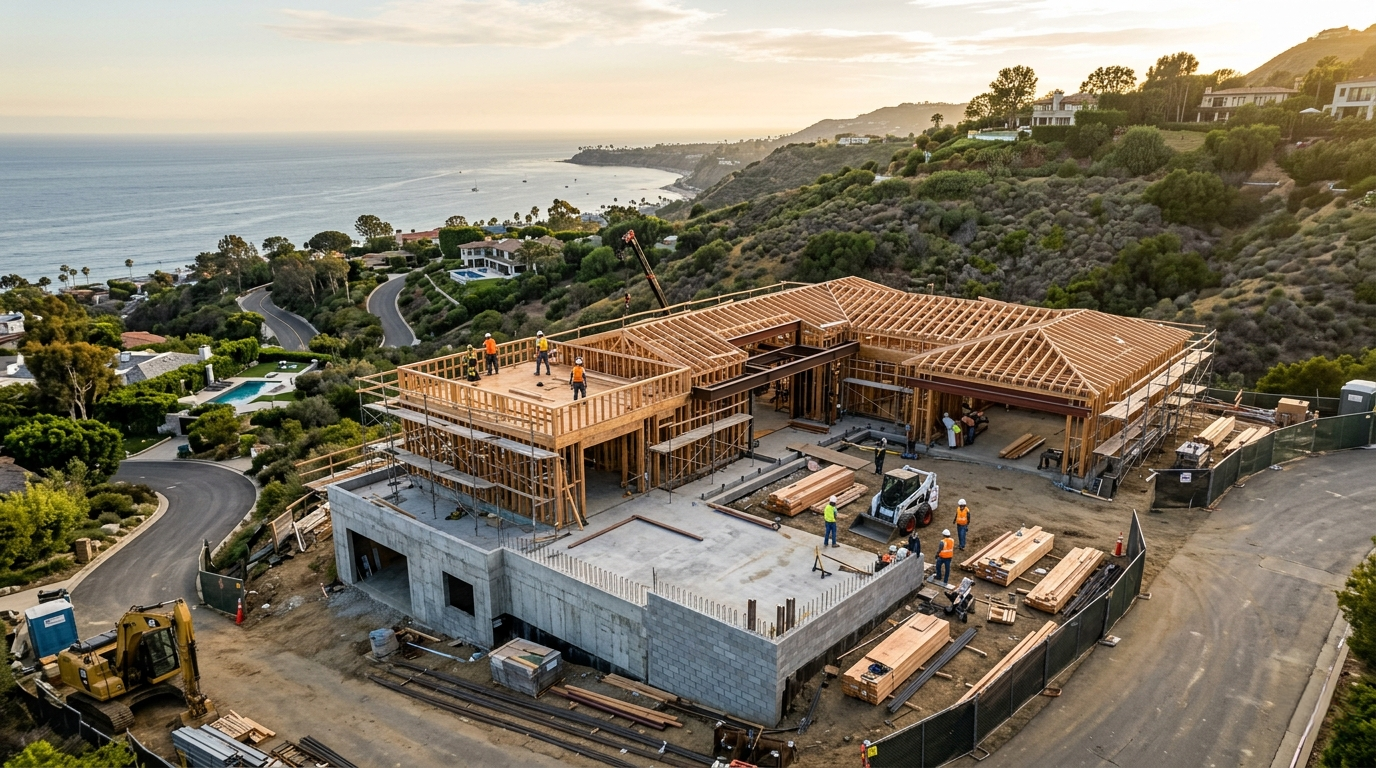
One year after the January 2025 fires, the recovery in Pacific Palisades is real — but slower than almost everyone anticipated. Thousands of homeowners are still navigating the permits, the insurance claims, the regulatory agencies, and the contractors. This guide covers all of it, in plain language, with no jargon and no runaround.
This guide is written specifically for Pacific Palisades — the Riviera, Alphabet Streets, Rustic Canyon, the Highlands, Castellammare, and Marquez Knolls. While some rules apply statewide, many sections (Coastal Commission, soils reports, HOA approvals) are specific to this neighborhood. If you're in Altadena, some rules differ.
Why Is the Rebuild Taking So Long?
The most common question we hear from Palisades homeowners is: "Why is this taking so long?" The answer is not laziness, contractor shortages, or red tape for its own sake. It's the structural reality of rebuilding in one of the most regulated construction environments in California.
A fire rebuild permit in Pacific Palisades is not a single approval. It is a coordinated set of permits and clearances from multiple agencies — each with their own review timelines, requirements, and staff capacity. Understanding who those agencies are, and what they each need from you, is the first step to moving faster.
"Rebuilding in Pacific Palisades means navigating a regulatory environment that is more rigorous, interconnected, and time-sensitive than anywhere else in Los Angeles."
The Four Agencies You'll Deal With
Most other parts of Los Angeles involve LADBS and that's it. In Pacific Palisades, depending on your lot, you may need clearance from all four of the following:
LADBS (LA Department of Building & Safety) — The primary permit authority. Handles structural plan review, inspections, and certificate of occupancy. Their target review time for a complete fire rebuild application is 30 business days, though real-world timelines vary.
California Coastal Commission — Required for properties in the Coastal Zone (this covers most of Pacific Palisades, including Castellammare and large portions of the Riviera). Governor Newsom's executive orders suspended Coastal Act review for qualifying fire rebuilds — but not all projects qualify automatically. We cover this below.
LA County Grading Division — Hillside lots require geology and soils reports submitted here before the foundation can be approved. Most Palisades lots above flat street level trigger this requirement.
HOA / Architectural Review Board — The Riviera HOA and other community associations in the Palisades have their own design approval process. This runs parallel to city permits but must be resolved before you can break ground.
What the Executive Orders Actually Changed
In response to the January 2025 fires, Governor Newsom and Mayor Bass each issued executive orders designed to speed up the rebuild process. Understanding what these orders actually do — and what they don't do — is essential.
Governor Newsom's Executive Orders (N-4-25 and N-5-25)
Signed January 12, 2025. These orders suspend CEQA (California Environmental Quality Act) and the California Coastal Act for reconstruction projects on fire-damaged properties. In practical terms, this eliminates the environmental review delays that typically add months to a coastal project timeline.
What this means: If you are rebuilding a like-for-like home (or up to 110% of the previous footprint) in the Coastal Zone, you generally do not need a full Coastal Development Permit. The 60-day Coastal Commission review timeline under AB 462 applies to ADU projects in the Coastal Zone specifically.
Mayor Bass's Emergency Executive Orders
Three orders are most relevant to Palisades homeowners:
The 110% Footprint Rule — How Big Can You Build?
One of the most important rules for Palisades homeowners is the 110% footprint rule. Under the current streamlined rebuild framework, you can rebuild your home up to 10% larger than the structure that existed before the fire — with no design review, no conditional use permit, and no neighborhood review process.
This applies to the habitable square footage of the primary home. ADU square footage is calculated separately and is not subject to the 110% cap — new detached ADUs on the lot are permitted regardless of whether one existed before.
Important: The 10% expansion applies to the Palisades fire zone specifically. Measure your pre-fire footprint carefully — using your pre-fire permit records, assessor documents, or a licensed surveyor — before submitting plans.
What Counts Toward the Footprint?
Conditioned living space counts toward the 110% calculation. Garages, detached structures, and ADUs are typically calculated separately. If your home had an attached garage, discuss with your contractor how this is treated in your specific case, as interpretations can vary by application.
Going Larger Than 110%
If you want to rebuild more than 110% of your previous square footage, you exit the streamlined process and return to the standard discretionary review system — which includes neighborhood notifications, design review hearings, and a significantly longer timeline. For most homeowners, staying within the 110% limit is strongly advisable.
The LADBS Standard Plan Pilot Program
One of the most significant time-saving options available to Palisades homeowners is the Standard Plan Pilot Program, launched by LADBS specifically for fire rebuilds. This program offers a library of pre-approved, code-compliant home designs that have already been reviewed for building code compliance by LADBS.
Choosing a pre-approved plan eliminates most of the plan-check phase — the single most time-consuming step in the permit process. The first post-fire permit in the Palisades was issued in 57 days using a standard plan — roughly three times faster than pre-fire averages.
| Approach | Typical plan check timeline | Cost (plan check fees) | Design flexibility |
|---|---|---|---|
| Standard Plan (pre-approved) | 1–5 business days | Waived under EO No. 7 | Interior customizable; exterior fixed |
| Custom architect plans | 30–90+ business days | Waived under EO No. 7 | Full design control |
| Architect self-certification | Immediate (architect certifies) | Waived under EO No. 7 | Full design control |
Timelines are based on complete applications. Incomplete submissions restart the clock. Under AB 253, if LADBS exceeds 30 business days for plan review, you may request a qualified third-party reviewer at no additional cost.
Should You Use a Standard Plan?
Standard plans work well if your lot is relatively flat, your rebuild is straightforward, and you're prioritizing speed over design customization. They are not the right fit for complex hillside lots, custom architectural requirements, or homes with significant elevation changes that require custom foundation engineering.
Our recommendation: review the available plans with your contractor before committing. A good contractor can tell you in 30 minutes whether a standard plan is viable for your specific lot conditions.
Coastal Commission — What Still Applies to You
Most of Pacific Palisades sits within the California Coastal Zone — which normally means any new construction or significant alteration requires a Coastal Development Permit (CDP) in addition to standard LADBS permits. The January 2025 executive orders changed this significantly for fire rebuilds, but understanding exactly what applies to your project is critical.
What's Suspended for Fire Rebuilds
CDP requirement for like-for-like rebuilds (up to 110% of previous footprint) on fire-damaged properties
CEQA environmental review for qualifying reconstruction projects
Standard 6–12 month Coastal Commission review timeline for qualifying projects
What Still Requires Coastal Commission Review
Rebuilds that expand beyond 110% of the previous footprint
New structures on lots that did not previously have a home (undeveloped coastal lots)
Projects within 10 feet of a canyon bluff or 25 feet of a coastal bluff — these have specific setback requirements regardless of fire rebuild status
ADUs in the Coastal Zone — under AB 462, the Coastal Commission must issue a decision within 60 days of receiving a complete application, but a CDP is still technically required (though expedited)
2026 WUI Code — What It Means for Your Rebuild
Effective January 1, 2026, California's new WUI (Wildland-Urban Interface) building code — officially Title 24, Part 7 — became mandatory statewide. This is the most significant restructuring of wildfire construction standards in decades, and it applies to every home rebuilt in Pacific Palisades, which sits in a designated Very High Fire Hazard Severity Zone.
The 2026 WUI code consolidates requirements that were previously scattered across multiple code sections. Under this code, every fire rebuild must meet the following minimum standards:
Roofing: Class A fire-rated roofing assembly. Concrete tile, metal, or equivalent. No wood shake, even with fire-retardant treatment.
Vents: All vents (eave, soffit, attic, foundation) must be ember-resistant, meeting ASTM E2886 compliance. This is one of the most overlooked requirements and a common reason for failed inspections.
Exterior walls: Noncombustible or ignition-resistant exterior cladding. Fiber cement, stucco, stone, brick, or equivalent. No vinyl siding in a VHFHSZ.
Decks and exterior structures: Noncombustible decking material. Composite decking with a Class A rating, concrete, tile, or similar. No standard wood decking attached to the main structure.
Defensible space: Zone 1 (0–30 feet from structure) and Zone 2 (30–100 feet) vegetation management requirements must be met before certificate of occupancy is issued.
Glazing: Windows and skylights must meet fire-resistant glazing standards in certain exposures. Multi-pane tempered glass is the common solution.
The main cost drivers are ember-resistant venting systems (which must be installed throughout the structure, not just at obvious locations) and noncombustible decking. These costs are typically covered under your insurance policy's "code upgrade" provision — confirm this with your adjuster before construction begins.
The 6-Year Code Cycle
Under AB 130, the 2026 WUI code will remain in force through at least 2031 — a six-year cycle instead of the traditional three. This means that what you build today will be code-compliant through the next cycle. Building to code now protects your investment from near-term obsolescence.
The ADU Strategy: Get Home Faster Under AB 462
One of the most powerful options available to Palisades homeowners — and one that is still underutilized — is building a detached ADU on your lot before or simultaneously with your primary home rebuild.
Assembly Bill 462, which took effect January 1, 2026, makes this strategy viable by allowing an ADU to receive its Certificate of Occupancy independently — even if the primary home has not been rebuilt yet. Previously, an ADU's certificate of occupancy was tied to the main house. If the main house was destroyed, the ADU technically could not be occupied. AB 462 eliminates this problem.
"Insurance settlements are taking 9–12 months. Full home permits are taking 6–9 months. Construction is another 12–18 months. That's potentially 2.5 years paying rent somewhere else. An ADU can change that math entirely."
How the ADU-First Strategy Works
- 1
Begin ADU planning and permitting immediately — do not wait for your insurance settlement to arrive. The permitting work runs in parallel with your settlement negotiation.
- 2
Select a pre-approved ADU plan from the LADBS Standard Plan catalog. These plans can pull a permit in as little as 1–3 business days for qualifying lots.
- 3
Build the ADU. A detached 750–1,000 sq ft guest house can typically be completed in 4–6 months from permit approval.
- 4
Receive your Certificate of Occupancy for the ADU and move home — legally, before your primary home is rebuilt.
- 5
Continue primary home permitting and construction while living on your own property. You have up to 7 years from the date of the applicable executive order to obtain a permit for the primary home.
If you held ownership of your Palisades property before January 7, 2025, both your primary home rebuild permit and any ADU permit fees are waived. This can save several thousand dollars in upfront costs.
Working With Your Insurance Company
For most Palisades homeowners, the insurance process is running parallel to — and sometimes longer than — the permit process. Understanding how to work effectively with your adjuster, and what your contractor should be handling on your behalf, can significantly reduce delays and improve your settlement.
The Most Important Thing Most Homeowners Don't Know
Don't wait for your insurance settlement to start the permit process. This is the single most common mistake we see, and it adds 6–12 months to a rebuild timeline. Settlement negotiations and permit applications can — and should — run simultaneously. By the time your settlement arrives, your permits should be close to approval.
Code Upgrade Coverage
Most homeowner policies include "code upgrade" coverage — also called "ordinance or law" coverage — which covers the additional cost of bringing your rebuilt home up to current code standards. The 2026 WUI code requirements (ember-resistant venting, noncombustible cladding, Class A roofing) are the most significant code upgrade cost items for Palisades rebuilds.
Confirm with your adjuster before construction begins that your code upgrade coverage specifically includes WUI compliance costs. Get this confirmation in writing. If your policy does not include it or the coverage is insufficient, this is worth contesting or supplementing before you break ground.
How Your Contractor Should Help
A qualified contractor should be doing more than just building. Their project manager should be:
Coordinating directly with your insurance adjuster and providing itemized scope-of-work documentation
Documenting all WUI-required upgrades separately in the estimate so they are clearly identified as code-required costs
Supporting supplemental claim submissions if the initial settlement does not cover full replacement cost
Providing evidence of code compliance for each WUI requirement, which your adjuster may request
Realistic Timeline: What to Expect From Start to Move-In
The honest answer is that a full fire rebuild in Pacific Palisades — from initial planning to certificate of occupancy — takes 12 to 24 months for most projects. Complex hillside lots, coastal bluff properties, or custom designs can take longer. Here is a realistic breakdown of the major phases:
| Phase | What happens | Typical duration | Who leads it |
|---|---|---|---|
| Debris clearance | State or FEMA-funded clearance of burned structure and hazardous materials | Already underway or complete for most lots | State / FEMA |
| Design & planning | Architect selection, design development, soils report, plan preparation | 4–10 weeks | Architect + contractor |
| Permit submission | LADBS, Coastal Commission (if applicable), Grading Division, HOA — simultaneously | 1–4 weeks to submit | Contractor |
| Plan check / review | Agency review of submitted plans; corrections and resubmittals possible | 30–90 business days (varies by agency and complexity) | Agencies |
| Permit issuance | All approvals received, permits issued, construction ready to begin | 1–2 weeks after approval | Contractor |
| Construction | Foundation, framing, systems (mechanical, electrical, plumbing), finishes | 8–16 months depending on size and complexity | Contractor |
| Final inspections & CO | LADBS final inspection, defensible space sign-off, certificate of occupancy | 2–6 weeks | LADBS + contractor |
Timeline assumes a complete, well-documented application submitted simultaneously to all applicable agencies. Incomplete submissions, plan check corrections, and sequential (rather than parallel) agency submissions can add 4–8 months.
The 6 Biggest Mistakes Palisades Homeowners Make
After working with hundreds of Palisades homeowners and rebuild projects, these are the mistakes we see most often — and the ones that add the most time and cost to the process.
Hillside Lots — Special Considerations for the Palisades
Pacific Palisades is almost entirely hillside terrain. This creates a set of construction and permitting requirements that don't apply in flat urban neighborhoods, and that even experienced LA contractors sometimes underestimate.
Soils Reports and the Grading Division
Any rebuild on a geologically sensitive hillside lot requires a geology and soils report submitted to the LADBS Grading Section. This report must address slope stability, soil bearing capacity, drainage, and risk mitigation. The Palisades fire itself altered hillside conditions in many areas — burn scars change drainage patterns, soil stability, and erosion risk. These conditions must be assessed site-specifically.
A soils report typically takes 4–8 weeks to prepare by a licensed geotechnical engineer. This work should begin at the same time as your architectural design, not after your plans are complete. Running them in parallel saves significant time.
Foundation Engineering
Hillside foundations in the Palisades commonly require engineered solutions — caissons, grade beams, or deepened footings — that are significantly more expensive than standard slab-on-grade foundations. Budget for this early and confirm your insurance policy's coverage for foundation replacement at current code-compliant standards.
Retaining Walls and Drainage
Many Palisades lots have existing retaining walls that were damaged or destabilized by the fire. Walls over a certain height require their own engineering, permits, and inspections. Drainage systems that were removed with the original structure may need to be redesigned to meet current grading standards. Both of these items should be scoped into your initial project estimate.
Choosing the Right Contractor for a Palisades Rebuild
The contractor you choose for your Palisades fire rebuild is the single most important decision you will make in this process. Not because of their general construction skill — though that matters — but because of their regulatory knowledge, local relationships, and permit management experience specific to this neighborhood.
The right contractor for a Palisades rebuild should have demonstrable experience with all of the following:
LADBS fire rebuild permitting — including experience with the current streamlined process, simultaneous multi-agency submissions, and the AB 253 third-party review pathway
California Coastal Commission — direct experience navigating Coastal Development Permits, exemptions, and expedited reviews in the Coastal Zone
2026 WUI code compliance — practical experience specifying and installing WUI-compliant materials, not just awareness of the code's existence
Hillside construction — grading permits, soils report coordination, hillside foundation engineering, and retaining wall systems
Insurance coordination — experience working directly with adjusters, documenting code upgrade costs, and supporting supplemental claims
Quick Reference Summary
Here are the most important action items for Palisades homeowners starting the rebuild process today:
- 1
Start immediately. Don't wait for your settlement. Begin design, contractor selection, and agency submissions now — in parallel with your insurance negotiation.
- 2
Submit to all agencies simultaneously. LADBS, Coastal Commission (if applicable), Grading Division, and HOA should all receive applications at the same time.
- 3
Evaluate the Standard Plan Program. If your lot is appropriate, a pre-approved plan can save 2–4 months on plan check.
- 4
Explore the ADU-first strategy. Under AB 462, you can move home before your primary house is done. Many families don't realize this option exists.
- 5
Confirm your fee waiver eligibility. If you owned your property before January 7, 2025, your permit fees are waived. Apply for the waiver when you submit your permit application.
- 6
Verify WUI compliance costs with your adjuster. Code upgrade coverage should cover WUI compliance costs. Get this confirmed in writing before construction begins.
- 7
Choose a contractor with verified Palisades experience. Check CSLB license status, confirm Coastal Commission experience, and ask for references from other Palisades fire rebuild projects specifically.
Pacific Palisades Remodeling has managed fire rebuild permits, Coastal Commission submissions, and WUI-compliant construction in the Palisades for 18 years. CSLB License #982386.