
Soils Reports & Hillside Rebuilds: What the Grading Division Requires in Pacific Palisades
Rebuilds in geologically sensitive areas require geology and soils reports submitted to the LADBS grading section. Hillside lots in the Palisades — especially in the Highlands — almost always qualify. Here's what to expect and how long it takes.
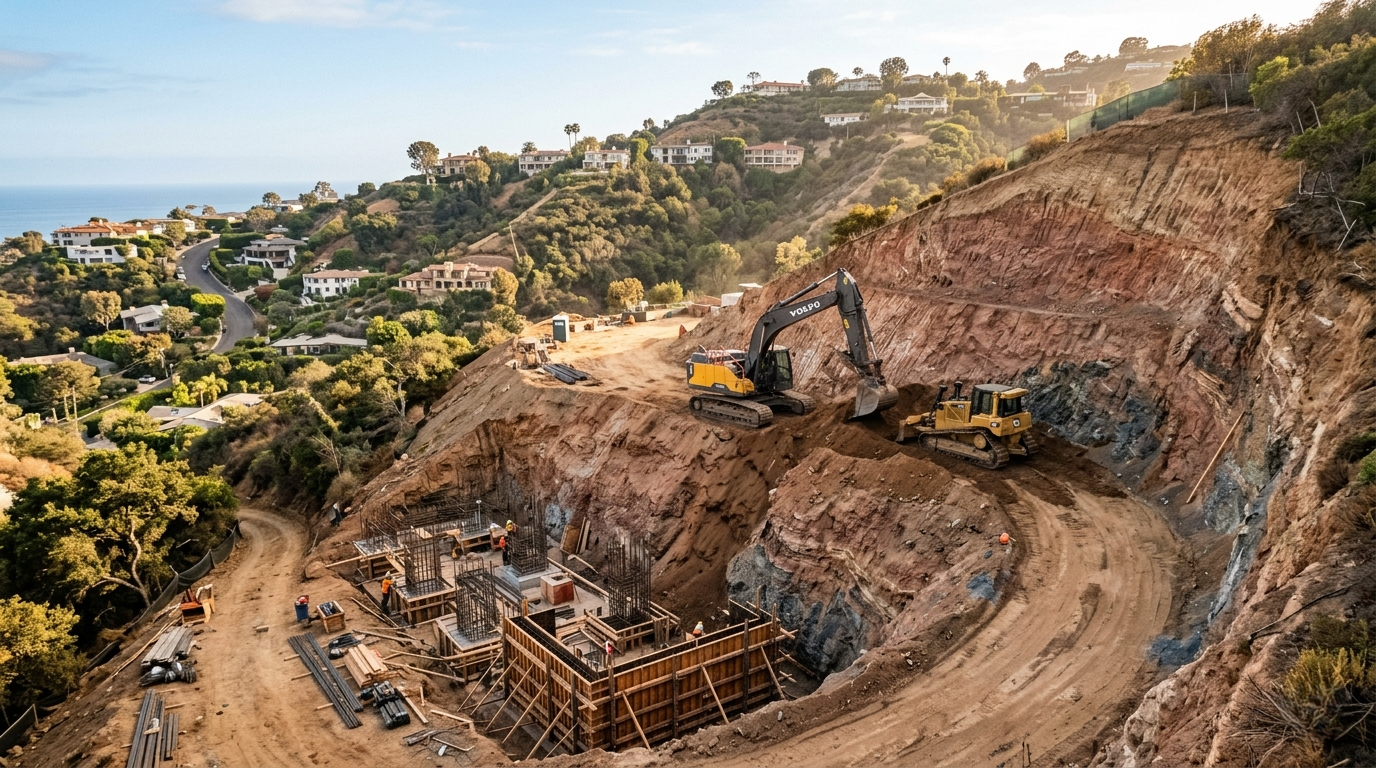
Pacific Palisades is almost entirely hillside terrain. The geology shifts by neighborhood — and the January 2025 fires changed the condition of that geology in ways that make post-fire soils assessments not just a bureaucratic requirement, but a genuine safety necessity.
The fire burned vegetation that was previously stabilizing hillside soil. Burn scars dramatically change drainage patterns, erosion rates, and slope stability — even on lots that had no geotechnical issues before the fire. This means that even properties whose pre-fire geology was straightforward may now require a more intensive soils assessment.
What Triggers a Grading Permit and Soils Report
In Pacific Palisades, a grading permit and accompanying geology/soils report is required when any of the following apply:
The lot has a slope of 10% or greater — which includes most of the Palisades outside of flat street-level lots in the central village area
The project involves grading, cut, or fill exceeding thresholds set by the LA County Grading Division — typically 50 cubic yards or more
The property is in a Hillside Area or Geological Hazard Zone as designated in the LA Municipal Code — the Highlands, upper Rustic Canyon, and much of the Riviera fall into this category
The foundation design requires site-specific geotechnical data — which is almost always the case for new construction on hillside lots where the previous foundation was destroyed
LADBS requires it as a condition of plan check — even where none of the above explicitly apply, a plan checker can require a soils report if site conditions warrant it
"The 2025 fires burned the vegetation that was holding slopes in place across the Palisades. Every hillside lot in the burn area should be assessed by a licensed geotechnical engineer before any foundation design begins — not as a regulatory formality, but as a genuine engineering necessity."
What a Soils and Geology Report Includes
A soils and geology report for a Palisades fire rebuild is prepared by a licensed California Geotechnical Engineer (PE) or Engineering Geologist (CEG). It typically includes:
Site reconnaissance and mapping — physical inspection of the lot, identification of existing slope conditions, burn scar areas, drainage patterns, and any visible signs of instability
Subsurface exploration — typically 2–5 borings or test pits dug at strategic locations to sample and characterize soil and rock conditions at depth
Laboratory testing — soil samples analyzed for shear strength, consolidation characteristics, expansion potential, and bearing capacity
Slope stability analysis — calculation of safety factors for existing slopes and any proposed cuts or fills, with identification of potential failure modes
Foundation recommendations — specific guidance on allowable foundation types (slab, caisson, grade beam, etc.), bearing pressures, depth requirements, and lateral design values
Drainage and erosion control recommendations — particularly important for post-fire lots where natural drainage patterns may have changed
Grading recommendations — specific requirements for any cut or fill areas, compaction standards, and slope gradient limits
Timeline and Cost
| Phase | Duration | Who does it | Typical cost |
|---|---|---|---|
| Geotechnical engineer engagement | 1–2 weeks | Contractor coordinates | Included in report fee |
| Site investigation (borings/pits) | 1–3 days on site | Licensed geotechnical engineer | Included in report fee |
| Lab testing and analysis | 2–3 weeks | Geotechnical lab | Included in report fee |
| Report preparation | 1–2 weeks | Licensed engineer | Included in report fee |
| LADBS grading division review | 3–8 weeks | LADBS Grading Section | Fee waived under EO No. 7 |
| Total from engagement to approval | 8–16 weeks | — | $4,000–$14,000 total |
Report costs vary based on lot complexity, slope, number of borings required, and the extent of post-fire damage assessment needed. Complex hillside lots in the Highlands can exceed the high end of this range.
The Critical Timing Point: Start the Report Immediately
The most common mistake Palisades homeowners make regarding the soils report is treating it as something to commission after their architectural plans are complete. This adds 8–16 weeks to the overall timeline unnecessarily.
The soils report informs the foundation design — not the other way around. Until you have the report, your structural engineer cannot finalize the foundation type, depth, and lateral design values. Starting the soils report on day one means:
The report arrives before or simultaneously with the completed architectural plans
The structural engineer can design the foundation correctly the first time
LADBS plan check and grading division review can proceed simultaneously
You don't discover foundation surprises after the permit is issued
Neighborhood-by-Neighborhood Differences
Not all Palisades neighborhoods have the same geotechnical conditions. Here is a general characterization — though site-specific conditions always override general neighborhood patterns:
| Neighborhood | Typical geology | Soils report likelihood | Common foundation type |
|---|---|---|---|
| The Highlands | Steep slopes, decomposed granite, landslide history in areas | Very high — almost certain | Caissons or grade beams |
| Rustic Canyon | Canyon bottom + slopes, alluvial soils, high moisture | High | Deepened footings or caissons |
| The Riviera | Hillside, variable — some areas stable, some with fill | High | Variable — site specific |
| Castellammare | Coastal bluff, marine terrace deposits, bluff stability concerns | Very high — bluff setbacks add complexity | Deep foundations, setback compliance |
| Alphabet Streets | Gentler slopes, more stable — but variable | Moderate — depends on specific lot | Standard slab or conventional footings on many lots |
| Marquez Knolls | Hillside, moderate slopes | High — most lots require assessment | Variable — often conventional with upgrades |
These are general characterizations only. Individual lot conditions within each neighborhood can vary significantly. A site-specific investigation is the only reliable way to establish actual foundation requirements.
We engage geotechnical engineers on day one and run soils investigations in parallel with architectural design — so you don't lose weeks waiting. Free consultation. CSLB License #982386.